 7
7Bot economics on small poker sites
Thin volume, real detection exposure, and a build cost that rarely pays back. A developer-and-research look at why a bot on a low-traffic room like 7XL is usually a losing proposition.
Bottom line up front. A poker bot earns by stacking a small per-hand edge across a large number of hands. A small room denies the hand count and amplifies the detection risk at the same time. Run the numbers and the typical small-room bot spends more on development, infrastructure, and account churn than it can realistically recover — while carrying a much higher chance of being shut down early. The edge is real; the volume to monetize it is not.
How a bot actually makes money
Strip away the mystique and a winning bot is a volume business. Its profit is roughly:
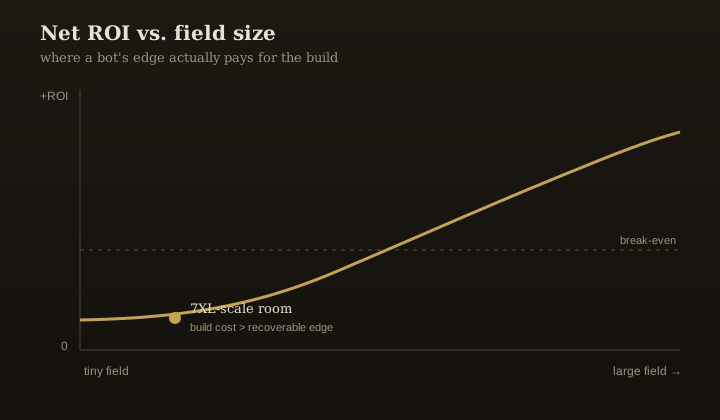
profit ≈ win_rate (bb/100) × hands_per_day × stake (bb in currency) − costsThe win rate of even a strong bot at reasonable stakes is small — a few big blinds per hundred hands. That edge only becomes money when multiplied by a large hand count. On a global site a multi-tabling bot can see tens of thousands of hands a day. On a small room, the same software might struggle to find enough live tables to play a few thousand. The multiplier collapses, and so does the profit.
It is worth dwelling on why the win rate stays small. Poker is a high-variance game, and a bot's edge is statistical, not deterministic — it wins a little more often than it loses, over the long run. Pushing the win rate higher means playing a sharper, more exploitative, more obviously machine-like style, which trades directly against stealth. So a realistic bot deliberately holds its edge down to stay hidden, and a held-down edge needs even more volume to turn into money. On a room that cannot supply that volume, the two requirements — stay quiet and stay profitable — pull in opposite directions and neither is fully satisfied.
The volume problem
Volume is the first wall. A bot cannot play hands that are not being dealt. If your target stake runs only two or three tables at peak and nothing for long stretches, the bot's daily hand count is capped no matter how good its strategy is. Multi-tabling helps only until you run out of tables — and on a small room you run out almost immediately.
Worse, the obvious "fix" — playing more aggressively or sitting at every table to maximize hands — is exactly what makes a bot visible. On a thin room the only path to meaningful volume is to dominate the lobby, and dominating a small lobby is the fastest way to get noticed.
The detection problem
The second wall is detection, and it scales the wrong way. On a small room, more volume buys you more profit and more exposure simultaneously, because the same community that you are grinding is watching closely.
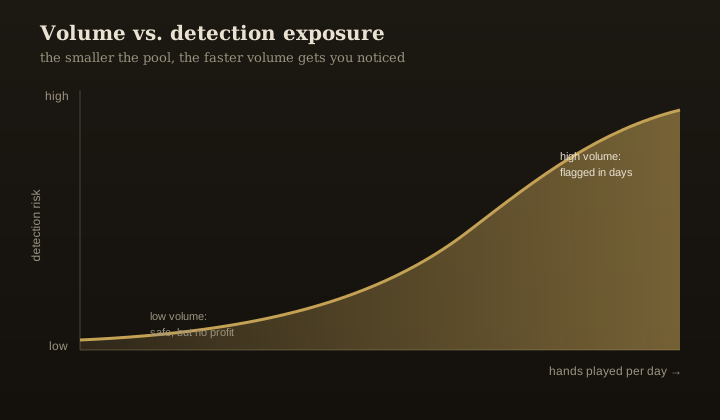
Detection on a small room comes from two directions at once. The operator's automated systems — timing analysis, input patterns, multi-account links — are the same tools big rooms use. But the human layer is proportionally stronger: regulars who recognize an account that never tilts, never breaks, and plays an unnervingly consistent line will report it, and a small operator acts on those reports quickly because protecting liquidity is existential. Every banned account also means burning a deposit and the cost of building a fresh, "aged" identity.
Putting numbers to it
The figures below are illustrative, not a price list — they show the shape of the problem on a small room versus a large one. They assume a competent bot, modest stakes, and realistic detection rates for a thin pool.
| Factor | Small room (7XL-scale) | Large international room |
|---|---|---|
| Live tables at target stake | 2 – 4 at peak, often 0 | Dozens, around the clock |
| Realistic hands / day / account | ~1,500 – 3,000 | ~15,000 – 40,000 |
| Time to noticeable footprint | Days to a couple of weeks | Months |
| Account lifespan before flag | Short — community + operator notice fast | Long — lost in the crowd |
| Recoverable gross edge | Low — capped by volume | High — volume multiplies the edge |
| Cost per burned account (deposit + aged identity) | Repeated often → dominates the P&L | Rare → marginal |
| Typical net result | Negative after build + churn | Positive only with scale and discipline |
The pattern is consistent: on a small room the volume is too low to earn much and the churn cost is too high to ignore, so the build's fixed cost — months of development, infrastructure, and ongoing identity management — is spread across a tiny, short-lived stream of profit. That is a textbook negative-ROI project.
A quick worked example makes the gap concrete. Suppose a bot holds a 3 bb/100 edge at stakes where a big blind is worth ten cents. On the large room, at 25,000 hands a day, that is roughly 750 big blinds, or about 75 dollars a day in gross edge — before costs, but a base you can actually build on. On the small room, at 2,000 hands a day, the same edge produces about 60 big blinds, or roughly 6 dollars a day in gross edge. Now subtract a share of the development cost, the infrastructure, and the periodic loss of a flagged account with its deposit, and the small-room figure goes negative almost immediately. These numbers are illustrative, but the ratio — an order of magnitude difference in volume — is the whole story.
The hidden costs people forget
- Development time. A bot that plays even passably well is a serious engineering effort. On a small room that sunk cost is amortized over almost no volume.
- Infrastructure. Servers, screen-scraping or API plumbing, anti-fingerprinting, and proxies all cost money whether or not the bot is winning.
- Account churn. Each flagged account costs a deposit plus the effort of building a believable replacement. On a thin room flags come fast, so this line item recurs.
- Liquidity collapse. A bot that scares off the casual players starves its own games. On a small room this feedback loop is quick and self-defeating.
- Opportunity cost. The same engineering effort applied to legitimate study tools or to operator-side detection has a far better expected return.
When could the math flip?
Intellectual honesty requires acknowledging the edge cases, because they sharpen rather than soften the conclusion. There are narrow conditions under which a small-room bot looks less hopeless — and each one is fragile.
- An unusually soft, unprotected room. If an operator runs almost no detection and the pool is full of weak players, the per-hand edge can be large enough that even low volume earns. But "weak players and no enforcement" is precisely the kind of room that does not survive long, and word travels.
- A bot you already own. If the development cost is already sunk — say a researcher built the engine for another purpose — the marginal cost of pointing it at a small room is lower. The volume ceiling and detection risk still apply, so the upside stays capped.
- Pure research, no money. Running an agent in a play-money or sanctioned test environment to study behavior is a legitimate use with no ROI requirement at all. That is research, not botting, and it sidesteps the entire economic argument.
Notice that none of these describe the common case: an individual building a bot from scratch to profit on a live small room. For that scenario the math does not flip. It stays negative, and the edge cases only confirm why.
The research takeaway
For a developer or researcher, the small-room case is genuinely instructive: it isolates the variable that big rooms hide. Bot profitability is dominated by volume, and volume is exactly what a small pool cannot supply without triggering detection. The two constraints — thin volume and fast detection — are not independent; they are the same constraint viewed from two sides, and together they push the expected return below zero for any realistic build.
If you came here wondering whether a 7XL bot is worth building, the honest engineering answer is: almost never. The defensible uses of software on a small room are personal study and operator-side protection, both of which are covered in the room profile. For the one-paragraph version, see the home page.

Poker Software Expert & Communications Lead at Poker Bot AI